|
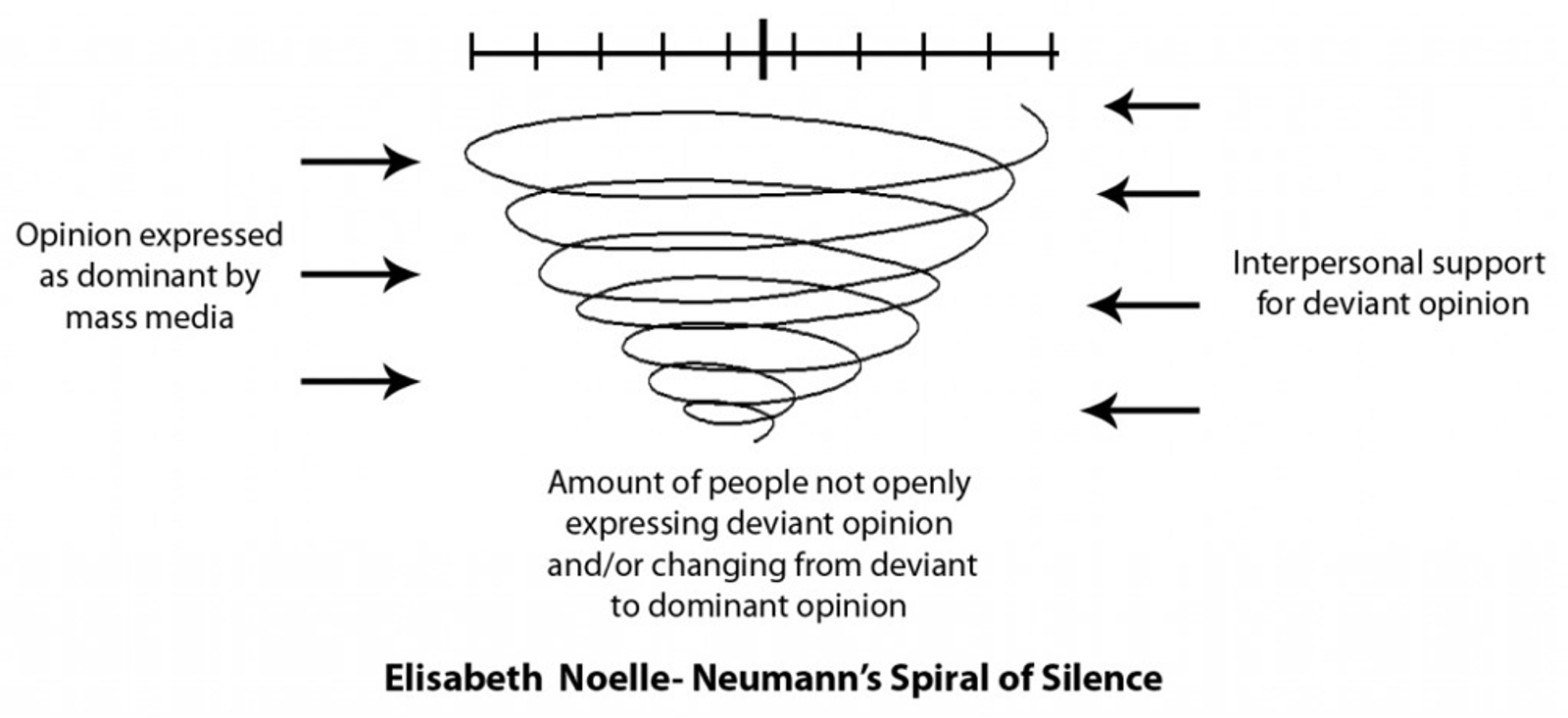
Blog March 1, 2025 "Spiral of Silence" the pitfall of AI Search: What is Social Intelligence? And why it is the future?Imagine logging onto your favorite forum or social feed, eager to discuss a controversial topic. You hesitate. The loudest voices all seem to share only a few opinions, and it’s not yours. Do you speak up, or stay silent? In today’s digital world, many of us have felt this tension. We’re swimming in a sea of information, yet it often feels like we’re hearing the same few voices over and over. Why do so many people hold back their true thoughts online? And how is the rise of AI – especially those helpful large language models (LLMs) like ChatGPT – potentially making this problem worse? These questions are at the heart of the “spiral of silence” phenomenon and point toward a solution grounded in social intelligence. When AI Search (Answer Engine) becomes an Echo ChamberEnter the age of AI assistants and advanced LLMs, which promise quick answers to any question. It’s a marvel of technology – ask a question and get a coherent answer in seconds. But there’s a hidden risk: if millions of people are relying on the same AI models trained on the same giant pool of internet text, will we start to get the same answers? Will we lose the nuanced, quirky, local, or expert viewpoints that make human knowledge so rich? It’s not just a hypothetical concern. Research is already noting a worrying trend: as different users incorporate suggestions from the same AI model, there is a risk of decreased diversity in the produced content, potentially limiting diverse perspectives in public discourse. In one study, writers asked to co-write essays with an AI assistant ended up with more homogenized essays – using a particular LLM led to a statistically significant reduction in diversity of content, making different authors sound more similar. Another team of researchers found that AI-generated responses were much more alike each other than human responses were, even across different brands of AI. If today’s LLMs are all trained on the same internet texts and tuned in similar ways, using them widely could funnel us into a narrow range of expressions. Why does this happen? Part of the reason is how these AI models work. They’re trained to predict likely responses based on patterns in their data – which means they often converge on the most statistically average answer. One analysis noted that such systems show a strong bias toward majority cultures, perspectives, and modes of thinking, and as more AI-generated content floods online, future models may further entrench majority views and create more homogeneous content. In a worst-case scenario, if each new generation of AI learns from content produced by the previous generation, we get a feedback loop of sameness. The spiral of silence could thus acquire a high-tech twist: instead of mass media or peer pressure making one opinion dominant, it could be our go-to AI answers that set the narrative and subtly discourage us from seeking alternatives. If an AI assistant consistently gives a certain viewpoint – drawn from the prevailing wisdom of its training data – users might never encounter the minority perspective at all. Over time, those unvoiced perspectives fade further. Even search engines are integrating AI summaries on top of search results, which, while convenient, can choke off traffic and attribution to the diverse sources of information on the open web. Theory: The Spiral of Silence and the Fear of Speaking UpIn the 1970s, German political scientist Elisabeth Noelle-Neumann coined the term Spiral of Silence to describe a powerful social force. Her theory refers to the increasing pressure that people feel to conceal their views when they think that they are in the minority. In simple terms, if you believe your opinion isn’t popular, you’re more likely to stay quiet. This self-censorship is driven by a very human fear: the fear of isolation or ostracism. We’ve all seen this play out. On a social network, a bold stance gets wide approval and rises to the top, while opposing voices retreat for fear of being ridiculed or attacked. Over time, one viewpoint appears unanimous – not necessarily because everyone agrees, but because those who don’t have effectively been silenced. John Stuart Mill warned about this danger long before the internet: even if all of society minus one person shared the same opinion, silencing that one dissenter would be an injustice. That lone voice could hold a piece of the truth.
The Algorithmic Conformity CrisisThe Political and Philosophical ImplicationsThroughout history, control over information has been a fundamental mechanism of power. From the Catholic Church’s censorship in the Middle Ages to state-controlled media in authoritarian regimes, controlling narratives dictates societal behavior. In the 20th century, mass media structured public discourse; today, social media algorithms and AI-generated content wield even greater influence, subtly shaping what we perceive as truth. Michel Foucault’s work on discipline and power reminds us that knowledge structures society — and those who control discourse shape reality. Social media platforms claim neutrality, yet their algorithms function as gatekeepers, amplifying certain voices while silencing others. When AI-generated content becomes the default source of information retrieval, we enter a new phase of digital hegemony, where diversity of thought erodes beneath the weight of self-referential machine-generated narratives. Hannah Arendt warned against the dangers of manufactured consensus — when individuals believe they are exposed to an objective reality but are in fact subject to engineered truths. This is the essence of today’s AI-driven information retrieval dilemma. Search engines, once designed to surface the most relevant or authoritative information, now risk devolving into self-reinforcing loops of AI-generated content. The Social Science PerspectiveJürgen Habermas emphasized the importance of the public sphere — a space where diverse voices engage in reasoned discourse to shape collective understanding. However, today’s social-media-driven information landscape is fracturing this sphere, leading to algorithmic filter bubbles and reinforcing ideological echo chambers. Instead of fostering debate, AI-driven search results often prioritize engagement metrics, amplifying polarizing or lowest-common-denominator content. This is why Currents is not building another AI answer engine. Instead, the focus is on retrieving real user voices — the messy, diverse, and valuable human-generated content that algorithms often neglect. By prioritizing long-tail user-generated content, niche communities and their perspectives are less likely to be drowned out by AI-generated noise. Social Intelligence: The Future of AI Search and Business GrowthAt its core, social intelligence is about understanding the human digital footprint in real time. Unlike conventional AI search engines that simply provide direct answers, social intelligence systems analyze large amounts of user-generated content to extract trends, insights, and emerging narratives. This matters not just for search, but for businesses working in marketing, product development, and competitive intelligence. Many businesses focus only on positive reviews and competitor successes. But some of the most valuable insights come from negative reviews and customer complaints — signals that reveal gaps in the market. Those signals show where products fail, where users feel pain, and where differentiated opportunities exist. The recent rise of low-cost AI models also changes the economics of social intelligence. Large-scale mining of social signals, once expensive and limited to very large companies, is becoming accessible to smaller teams and startups. That shift opens the door to more context-aware, socially grounded AI products. The Next Era: AI as a Trusted, Context-Aware PartnerThe next frontier of AI is not just search, but trusted, social intelligence. The most useful AI is not one that merely answers queries, but one that understands human context — a system that can surface disagreement, map communities, and preserve nuance rather than flatten it. In a world drowning in AI-generated noise, the key is not just better answers. It is better questions — and better ways to find the people who are asking them. As an individual, how to break the spiral?Embracing social intelligence is one way to push back against the spiral of silence in the digital era. By designing AI tools to elevate diverse perspectives, we can counteract the homogenizing forces that plague online discourse. The future of information should not be an AI monologue; it should be a richer dialogue where AI helps surface real voices. The stakes are high. The value of authentic discourse — for democracy, innovation, and mutual understanding — cannot be overstated. We are at a crossroads where we can either slide into an information landscape dominated by self-referential AI chatter, or use AI more wisely to champion human-centric knowledge. By being aware of the spiral of silence, by seeking out multiple viewpoints, and by supporting platforms that prioritize real voices, we can help ensure that the future of the online world remains a thriving ecosystem of ideas rather than a barren monoculture. Original version published at Currents. |